investopedia

วันเสาร์ที่ 27 กุมภาพันธ์ พ.ศ. 2559

Meetme

MeetMe: Where People Meet And Investors Make Money

Summary

MeetMe trades at ~6x EV/2016 consensus EBITDA, a 50% discount to comps, despite growing its Mobile business at a 95% 3-year CAGR.
MeetMe's financial leverage is powerful, and MEET should convert ~55% of incremental Mobile revenue dollars to free cash flow.
MeetMe is in the early innings of optimizing its Mobile advertising strategy and is already seeing dramatic increases in ARPU.
Pinnacle Fund - Dallas, TX - Greg@Pinnaclefund.com
MeetMe, Inc. (NASDAQ: MEET)

BUY Recommendation. Current Price $3.20, Price Target $5.70.

Fully Diluted Shares - 49.5m, Market Cap - $158m, Enterprise Value $144m, Cash $16.2m, Debt $1.7m, December Fiscal Year-End.

Overview

MeetMe is a location-based mobile chat app for connecting with new people. Unlike other social apps, 50% of people using MeetMe self-identify as looking for friendship as opposed to romance. MeetMe's users are able to see somebody's interests, a brief description, and several pictures. The CEO describes MeetMe as a digital bar targeting 18 to 30-year-olds.
MeetMe generates revenue from three business lines: Mobile (~80% of Revenue), Web (~10% of Revenue), and Social Theater (~10% of Revenue). ~90% of Mobile and Web revenue is from advertising, which differentiates MEET from subscription-centric dating companies. Subscription revenue is approximately 2% of Mobile/Web revenue, and in-app purchases make up the balance of Mobile revenue. Mobile revenue grew 66% year-over-year in the first 9 months of 2015 due to a fundamental change in the business: bringing mobile ad inventory management in-house.
MeetMe has developed a mobile app that has grown from 200,000 daily active users ("DAU") and 663,000 monthly active users ("MAU") in March 2011 to more than 1.1 million DAU and 4.0 million MAU in November 2015. MeetMe's Mobile business generated $6.1 million in 2012 revenue and has grown at a 94.7% CAGR to ~$45.0 million in 2015 through the effective monetization of its user base. MeetMe preannounced 4Q'15 earnings results on 1/6/2016 that beat company guidance; MEET will hold its 4Q'15 earnings call on 2/29/2016.
Investors should want to own MeetMe now because:
  • Management is in the early innings of optimizing its mobile ad management strategy.
  • MEET's financial leverage is powerful. ~70% of incremental Mobile revenue dollars convert to EBITDA, and ~80% of EBITDA converts to FCF. Therefore, ~55% of incremental Mobile revenue converts to FCF.
  • Valuation is cheap. MeetMe trades at ~6x EV/2016 EBITDA, has a 12.5% FCF yield, and is growing.
  • MeetMe is investing cash flow from operations into a share repurchase program.
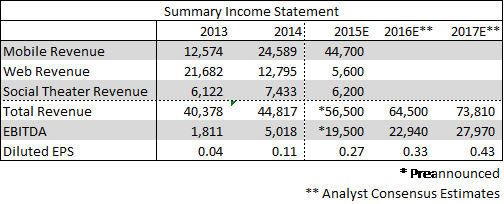
Below is a summary of MeetMe's Income Statement:
I would like to evaluate MeetMe by examining its:
  • Mobile Opportunity
  • Web Opportunity
  • Social Theater Opportunity
  • Management
  • Competition
  • Investment Risks
  • Operating Leverage
  • Valuation
  • Technical Analysis
  • Appendix

Mobile Opportunity - (~79% 2015E Revs, ~85% 2016E Revs)

Mobile Advertising Market
eMarketer's 2015 forecast expects mobile ad spending to increase nearly 100% from $30 billion in 2015 to $58 billion in 2018. The increase in mobile phone functionality is driving people to use their phone more.
Ask yourself, how often did you access the internet from your Motorola Razor in 2003? Or, how about your iPhone 1 in 2007 that had less RAM than most of today's smartwatches? Today's mobile technology is more conducive to consuming media on mobiles phones than in the past.
An April 2012 study by Pew Research Center finds that 55% of cell phone owners use their phone to go online. This is a dramatic increase from 31% of cell phone owners in April 2009. Consumer behavior is changing, and mobile phones are taking time share away from desktops/laptops.
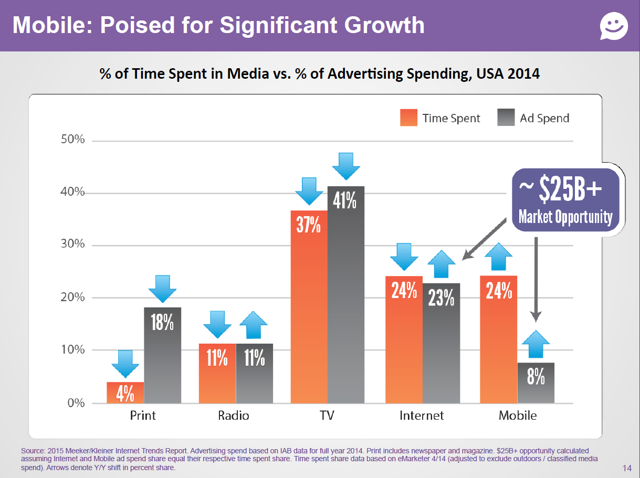
The chart below shows the percent of time spent in media relative to the advertising spend. Clearly, there is a huge discrepancy between the amount of time that people are spending on mobile devices and ad spend. If mobile ad spend caught up to time spent consuming media on mobile devices, mobile ad spend would have to increase by $25 billion, according to Kleiner Perkins analyst Mary Meeker's Internet Trends Report, based on IAB 2014 data.
(click to enlarge)(Source: MeetMe's January 2016 Investor Presentation)
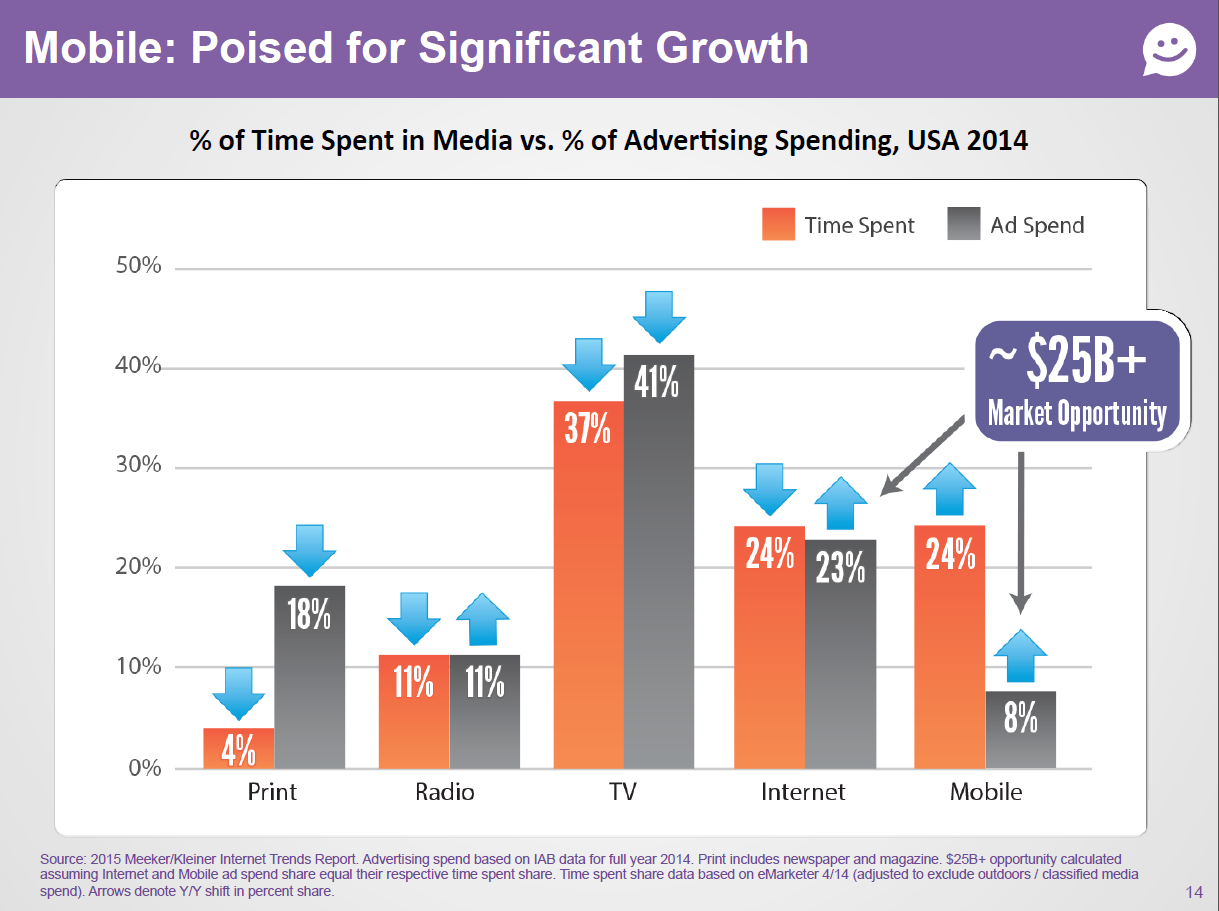
The amount of time people spend on mobile phones consuming media is increasing rapidly. And, Millennials are using their mobile phone more than older generations, and Millennials (Americans aged 18 to 34 years old) are entering prime wage years. In other words, Millennials are becoming bigger targets for advertisers.
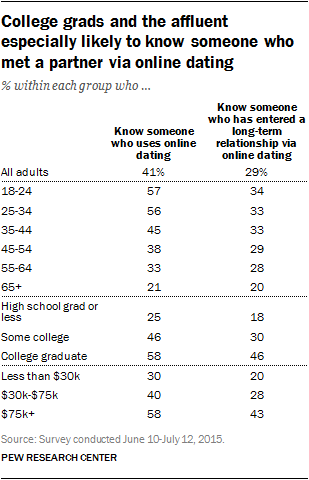
Where can advertisers find Millennials on mobile phones? How about the online dating industry? The negative stigma associated with online dating is dissipating. A July 2015 study by Pew Research Center reported that 22% of 18-24 year-olds use mobile dating apps, which is more than a 4x increase versus only 5% in 2013. Moreover, online dating awareness is highest among college graduates and the relatively affluent, an attractive demographic for advertisers. See a chart from Pew Research Institute below:
Great. We're agreed. Investing in a company levered to the mobile advertising market has a good macro. Targeting Millennials is even better. How do investors play this theme? Facebook is clearly attractively positioned, but at 19x 2016 EBITDA, it is not exactly cheap. MEET's Mobile advertising business is expected to grow revenues 20% year-over-year, and MEET is only trading for 6.2x 2016 EV/EBITDA and has a 12.5% FCF yield. Moreover, a peer of similar scale, PlentyOfFish, was recently acquired by Match Group for 12-13x forward EBITDA.
The MeetMe Mobile App
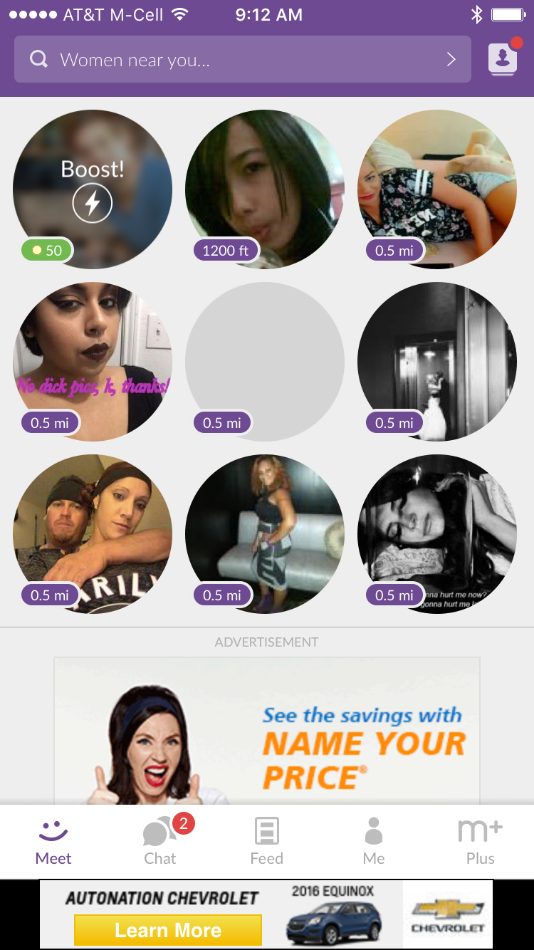
MeetMe is a location-based mobile chat app that serves more than 1.1 million daily active users ("DAU") and 4.0 million monthly active users ("MAU"). People use MeetMe with the hope of meeting a new friend or potential love interest. 54% of MeetMe users have met someone in person that they met through the app. MeetMe generates Mobile revenue from selling advertising, virtual currency, and subscription upgrades. Advertising, virtual currency, and subscription upgrades were 92%, 6%, and 2% of 3Q'15 Mobile revenue.
CEO Cook has made several improvements to the MeetMe app that improved the quality of the user experience resulting in 50% DAU growth and 70% MAU growth from Q1'13 to the end of 2015. But, the most important changes that Cook made over the last 3 years revolve around the mobile advertising strategy. Cook made 2 changes in 2015 that dramatically changed MEET's ability to generate higher mobile advertising revenue: 1) Reducing ad requests by 30%, and 2) taking mobile ad inventory management in-house.
Reducing ad requests by 30%
An ad request occurs any time that MeetMe requests an ad to fill an ad slot in its inventory. For example, the Chevrolet banner ad above filled one ad request and the Progressive native ad above also filled one ad request. When MeetMe requests a new ad to replace either of those ads, that is also an ad request. In April/May 2015, MeetMe made a basic change to its banner and native ads to increase ad duration, which improved click-through rates and dramatically improved advertising rates per ad.
Prior to April/May 2015, MeetMe ads refreshed as users navigated from "Meet" (a tab that suggests people in your area) to "Chat" (a tab that shows your friends that you can chat with) to "Feed" (a tab that shows recent posts from people in your area). Often, users were navigating between these tabs very quickly, and ads may not have had time to load. Ads may not have loaded in an astounding 30% of all ad impressions. This means that users may not have had a chance to determine if they wanted to click the banner or native ad because users never even saw the ad. As a result, these 30% of ad requests saw a 0.0% click-through rate ("CTR").
Very simplistically, higher CTRs result in higher advertising rates per ad (aka Cost-per-thousand impressions or "CPM"), and achieving CTRs above 0.4% results in significantly more competition for inventory. In other words, achieving CTRs greater than 0.4% means that more advertisers want to advertise in your app, which drives more competition for your ad inventory and higher CPMs.
In April/May 2015, MeetMe changed ad request protocol. Ads no longer refreshed every time a user moved between the "Meet", "Chat" and "Feed" tabs. Instead, ads started refreshing after about 10 seconds. Overnight, the 30% of ads delivering 0.0% CTRs were no longer a significant drag on total MeetMe CTRs because every ad loaded and users had the opportunity to view and click on all ads. MeetMe concurrently reduced the number of ad impressions by 30% and CTR increased 62% in July 2015 versus April 2015. I believe MeetMe increased its CTR above 0.4%, which led to higher quality advertisements from companies like Progressive, Chevrolet, Pepsi, Uber, Wal-Mart, Whole Foods, Google and others.
Taking Mobile Ad Inventory Management In-house
From October 31, 2013 to June 2, 2015, MeetMe outsourced its mobile ad management to a third party. Pinsight, a division of Sprint, managed MeetMe's mobile ad inventory from October 31, 2013 to February 28, 2015. Sprint's management change in January 2014 led to a winding down of Pinsight, and MeetMe was forced to change its mobile ad management platform. At the time, BeanStock already managed MeetMe's web ad inventory and assumed MeetMe's mobile ad inventory on March 1, 2015. BeanStock offers publishers (like MeetMe) a one stop shop to avoid the cost of building an internal mobile ad management team and earn more consistent advertising rates (aka Cost-per-thousand impressions or "CPM"). Mobile ad management platforms like BeanStock are able to perform important functions like running real-time auctions to fill ad inventory with the highest paying ad. In exchange, MeetMe agreed to receive a fixed price per ad from Beanstock. Therefore, BeanStock could make a lot of money if MeetMe's ad inventory was generating significantly greater CPMs than the fixed price BeanStock had to pay MeetMe.
On June 3, 2015, MeetMe fired BeanStock and brought mobile ad inventory management in-house in order to capture economics that it was giving to BeanStock. MeetMe saw an opportunity to optimize its advertising management strategy and made changes to its Ad Logic to serve more targeted ads. Targeted ads often have higher CTRs which result in higher CPMs and higher revenues. MeetMe has significant user data including: gender, age, relationship status, sexuality, interests, religion, ethnicity, and education. Just a guess, serving for-profit college education ads to college graduates probably wouldn't see high CTRs. MeetMe is early in the process of tailoring ads to match user interests.
The mobile ad management industry has evolved since the last time MeetMe managed its ad inventory in-house (October 30, 2013), and publishers can more easily manage their ad inventory today. Integrating with companies like Millennial Media and MoPub is drastically simpler and more effective than in 2013, and MeetMe is well equipped to manage its ad inventory with CRO Bill Alena's expertise and experience.
MeetMe's changes to its Ad Logic are already driving meaningful mobile advertising revenue growth. In 3Q'15, mobile CPMs, mobile ARPU and mobile ARPDAU year-over-year growth was 88%, 32% and 44%, respectively.
Please see a table of historical DAU, MAU, Mobile ARPU (Average Revenue per User) and Mobile ARPDAU (Average Revenue per Daily Active User) below.
(click to enlarge)
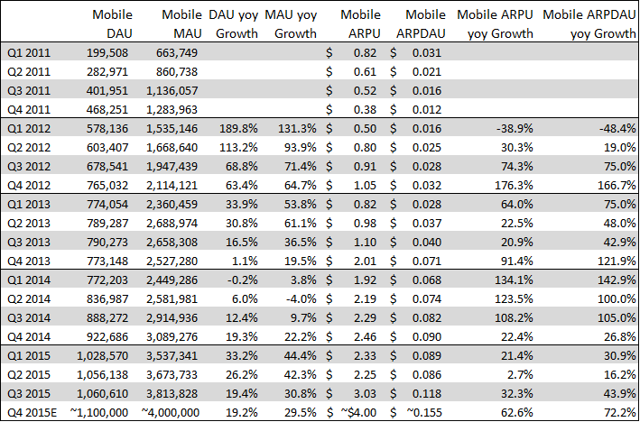
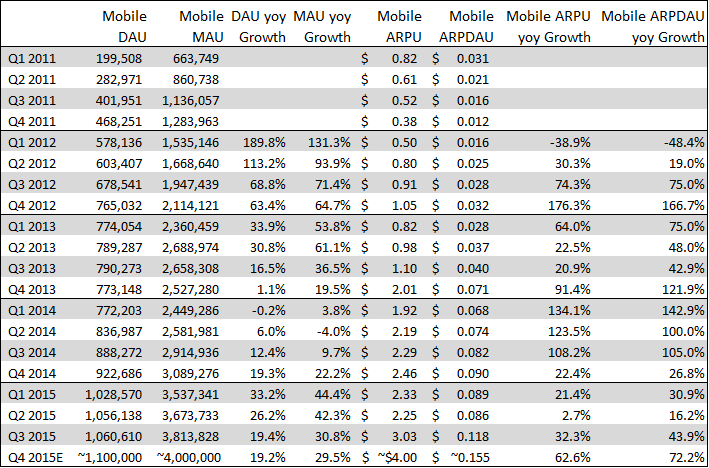
On January 6, 2016, management preannounced Q4'15 results that exceeded guidance. Press releases in 2015 announced that Mobile DAU exceeded 1.2 million for the first time on December 7, 2015, and Mobile MAU exceeded 4.0m in November 2015. These releases give us enough information to estimate that ARPU was ~$4.00 in Q4'15 and ARPDAU was ~$0.15, both of which are records for the company.
Mobile Opportunity Conclusion
MEET is attractively positioned to benefit from the large macro trend that mobile advertising spend is likely going to increase over the coming years. Furthermore, MEET has detailed information on its Millennial-centric user base that allows advertisers to target Millennials, who spend more time on their mobile phone than any prior generation. MEET's fundamental and sustainable changes to its Ad Logic over the last year are going to drive drastic increases in MeetMe CPMs and better monetization of its mobile user base.

Web Opportunity - (~10% 2015E Revs, ~5% 2016E Revs)

MeetMe's Web business is similar to its Mobile business. MeetMe.com allows users to perform most of the same functions as the mobile app. Millennials are accessing MeetMe from their desktop PC less often, thus leading management to spend less time and money developing the Web business. MeetMe's Web interface serves about 1.1 million MAU and 100,000 DAU.
I view the Web business is a business in secular decline that management will likely continue to run as a complement to the mobile app.

Social Theater Opportunity - (~11% 2015E Revs, ~10% 2016E Revs)

Social Theater is a different business model than the Mobile or Web businesses. Social Theater enables publishers to incentivize their users to take certain actions in exchange for the hosting platform's virtual currency. Social Theater advertising runs not only on MeetMe, but on other apps as well. For example, a freemium game that I downloaded on my iPhone may offer credits that allow me to upgrade gameplay. I can either buy these credits outright, or I could be offered a deal to watch a 30-second interstitial (full screen) video advertisement. In exchange for watching that ad, I could earn credits that I could use in the game. Social Theater receives ad revenue for placing an ad and has to buy the host platform's credits to issue credits to the user.
I view Social Theater as a flattish growth business with margins significantly less than corporate average. This business is still profitable and generates free cash, but Social Theater should not be core to an investor's investment thesis as it will continue to shrink as a percentage of total revenue.

Management

MeetMe's management team is strong for a $150 million market cap company. MeetMe's management team has a track record of success and is well equipped to successfully monetize its users.
Geoff Cook (Chief Executive Officer)
Cook has a history of successfully launching, growing and selling companies. Cook founded EssayEdge and ResumeEdge while a student at Harvard University in 1997 and sold both companies (organized under CyberEdit) to The Thomson Corporation (TORONTO: TRI) in 2002. Cook co-founded myYearbook in 2005 and grew it to $30 million in revenues before agreeing to be acquired by the Latino social networking site Quepasa (formerly NASDAQ: QPSA) in July 2011. Cook took on the Chief Operating Officer role at Quepasa in November 2011 at the time of the acquisition. On June 1, 2012, Quepasa Corporation changed its name to MeetMe, Inc., and MeetMe discontinued substantially all legacy Quepasa operations. Cook has been CEO of MEET since March 11, 2013.
David Clark (Chief Financial Officer)
Clark has experience as a Chief Financial Officer at several companies, most recently at Nutrisystem (NASDAQ: NTRI) from November 2007 through April 1, 2013. Prior to Nutrisystem, Clark was the CFO of Claymont Steel from November 2006 to November 2007. Clark also co-founded and served as the CFO of SunCom Wireless from February 1997 to February 2006. SunCom went public in 1999 and was later sold to T-Mobile in 2008. Clark has served as CFO of MEET since April 2, 2013.
Bill Alena (Chief Revenue Officer)
Bill served as Chief Revenue Officer of myYearbook from April 2007 until the myYearbook merger with Quepasa. Prior to working at myYearbook, Alena served as the Director of Internet Advertising at Scholastic Inc., a global children's publishing, education, and media company. Alena was also an early employee of DoubleClick. Alena has served as MEET's CRO since November 10, 2011.

Competition

MeetMe operates in a very competitive market and faces competition from websites and mobile applications whose primary focus is to help users meet new people in their geographical area like Tagged, Badoo, Skout, Twoo, and Meetup. MeetMe also competes against social networking peers that focus on dating like Zoosk, Match, PlentyOfFish, Okcupid, and Tinder.
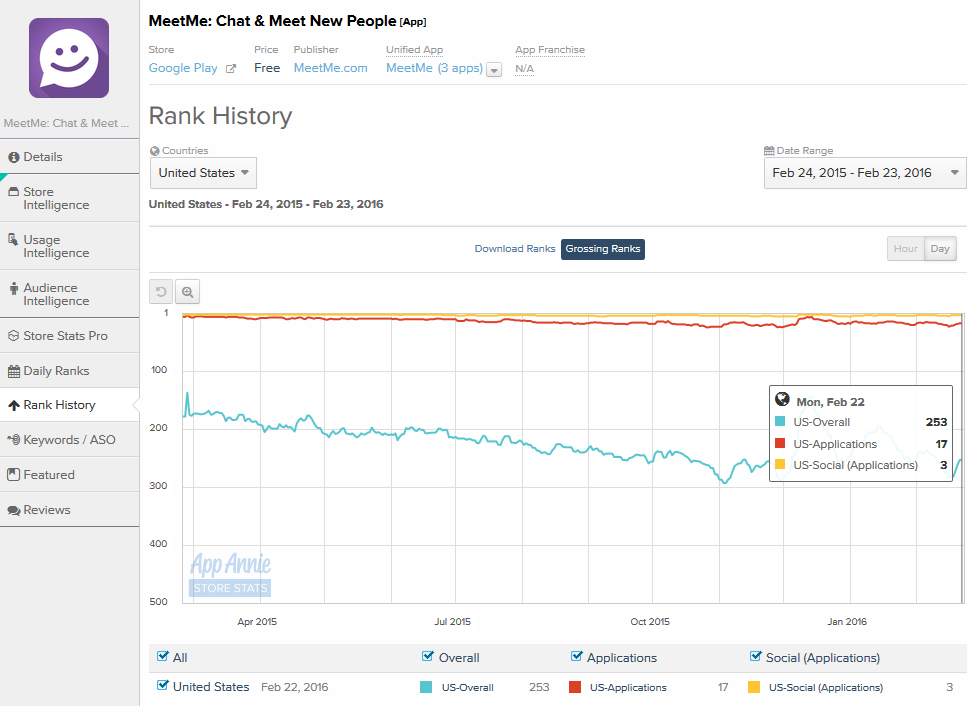
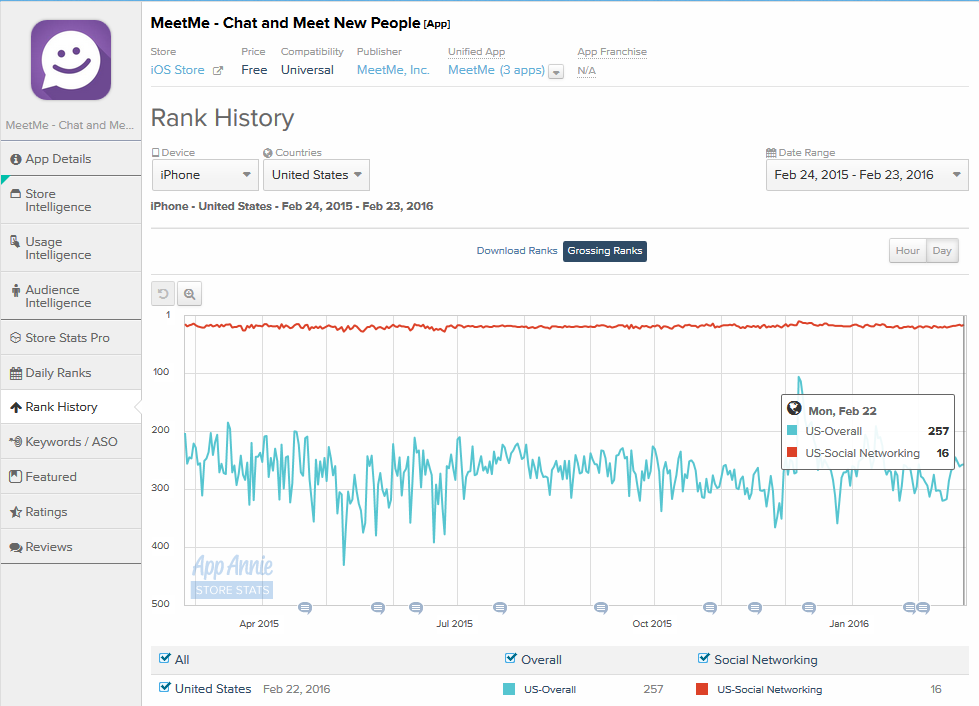
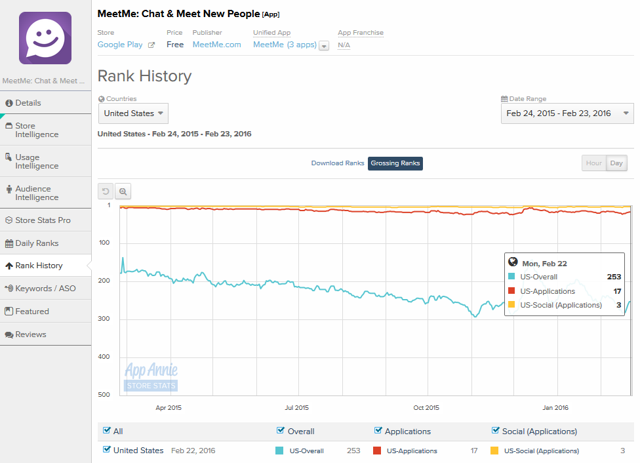
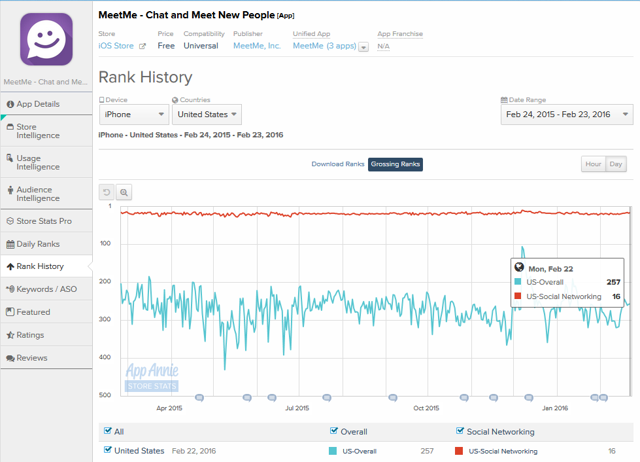
Like many of these competitive apps, MeetMe offers a good user experience, in my opinion. For the most part, these peers rank relatively well in the Google Play and iOS Store grossing ranks. MeetMe is outperforming some of these peers according to App Annie's Grossing Ranks. On February 22, 2016, MeetMe ranked #3 and #16 in US Social Application Grossing Ranks on Google Play and iOS Store, respectively.
MeetMe Google Play Grossing Ranks (Last 365 Days)
(click to enlarge)(Source: App Annie)
MeetMe iOS Store Grossing Ranks (Last 365 Days)
(click to enlarge)(Source: App Annie)
Investment Risks

Mobile CPMs are seasonal with the first quarter being the weakest. MeetMe outsourced its mobile inventory management from October 31, 2013 to June 2, 2015. Investors may not understand that mobile industry CPMs may decrease ~30-40% sequentially from Q4 to Q1. Even if mobile CPMs decrease 35% sequentially in Q1'16, I believe CPMs will increase ~55% year-over-year in Q1'16.
Mobile ad impressions/user/visit will likely be down year-over-year in 1H'16 because management changed ad request protocol and reduced the number of ad requests but increased the duration of ad impressions. I believe a decrease in ad impressions/user will be offset by CPM year-over-year. Analysts may not appropriately model a decrease in ad impressions per user in 1H'16.
MeetMe operates in a very competitive space, and MeetMe's users could decrease if management fails to continue to develop new features that enhance and improve the user experience.
The mobile advertising market is nascent and has not gone through a major recession. The effect an economic recession would have on mobile CPMs is uncertain; however, during the Great Recession internet advertising rates fared better than all other media platforms. I believe the mobile advertising space today is similar to the internet advertising market in 2008. Internet advertising spend outperformed all other media platforms in the Great Recession.
MeetMe is growing its subscription offering, and CEO Geoff Cook would "like to see revenue from subscription at least double in 2016" from approximately $1 million in 2015. Match Group (NASDAQ: MTCH) reported disappointing subscriber growth in the Q4'15 quarter on February 3, 2016. Importantly, MEET's subscription revenue is only 2% of mobile revenue.
Facebook recently added ads to Instagram, and Match Group plans to monetize Tinder through ads. Mobile CPMs could decrease if many publishers all turn on mobile ads before demand has sufficiently developed.

Operating Leverage

MEET has attractive income statement leverage. After covering fixed costs, each Mobile advertising dollar has very little associated variable cost. Marketing cost is the major variable cost in the model. I assume each additional dollar of Mobile revenue contributes ~$0.70 to EBITDA, and 80% of EBITDA converts to free cash flow. Therefore, 55% of each incremental Mobile revenue dollar should convert to FCF.
CAPEX was initially guided to be $3 million in 2015, and later revised on the 3Q'15 call to be closer to $2 million for 2015. I expect that 2016 CAPEX needs will be roughly in-line with 2015, which is congruent with management commentary on the 3Q'15 earnings call.
Management paid down approximately $1.6 million in debt in the 9 months ended September 2015 to reduce total debt to $1.3 million. I expect management to continue to use FCF to pay down debt, and MEET could have ended 2015 with no debt outstanding.
MEET had $72m in net operating loss carryforwards at the end of 3Q'15 that will shield the company from cash taxes for the foreseeable future. I expect 2016 CAPEX, taxes and interest expense to be ~$3 million.
Analysts are currently expecting MEET to generate $64.5 million in 2016 revenue and $23 million in 2016 EBITDA. Therefore, I expect MEET to generate $20 million in FCF on $23 million in EBITDA.
What do you do with all that cash? Management announced a $3 million share repurchase program to be completed between September 30, 2015, and March 31, 2016, on the 3Q'15 earnings call. I expect management to continue to buy its stock at current levels with cash from operations.

Valuation - (see comp tables in appendix)

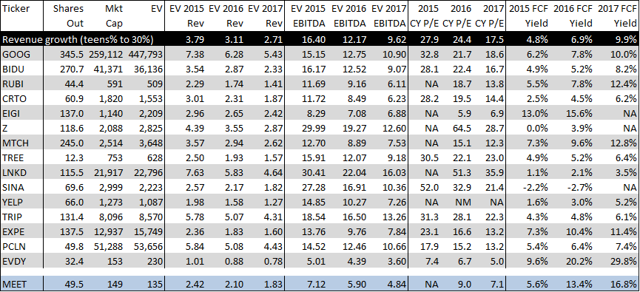
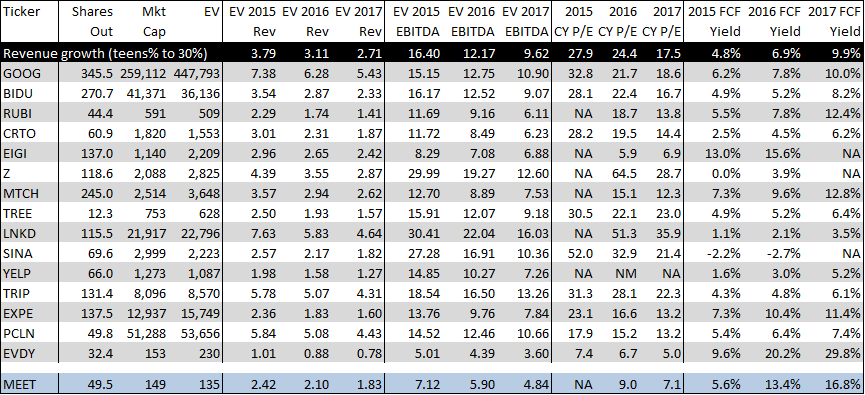
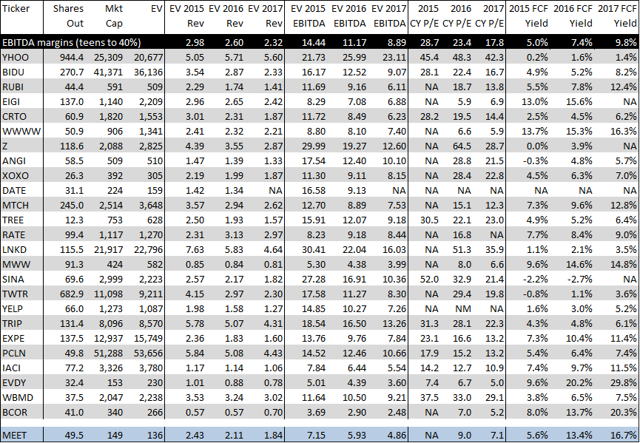
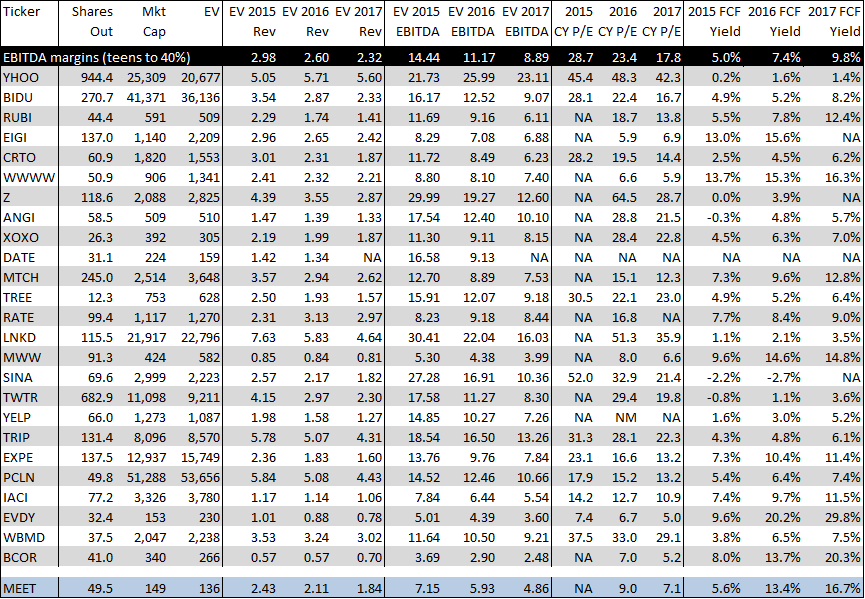
I examined MEET's valuation relative to internet peers based on several criteria:
  • Internet companies (n=15) with 2016 and 2017 expected revenue growth from 15% to 30%. MEET's revenue growth is expected to be 15% and 14% in 2016 and 2017, respectively.
  • Internet companies (n=25) with 2016 and 2017 expected EBITDA margins from 10% to 40%. MEET's EBITDA margins are expected to be 36% and 38% in 2016 and 2017, respectively.
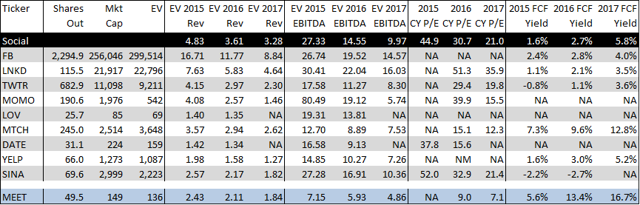
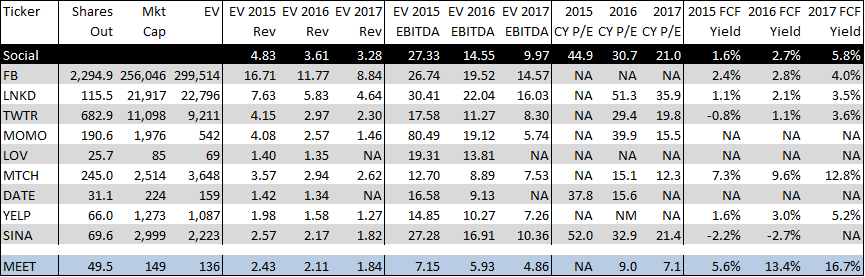
  • Social companies/industry comps (n=9).
Internet comps (see comps in appendix) trade for 11-12x EV/2016 EBITDA, 23-24x 2016 EPS, and have a 7% FCF yield as of February 3, 2016. MEET trades at 6.2x EV/2016 EBITDA, 11.8x 2016 EPS, and has a 12.5% FCF yield. MEET is trading at a ~50% discount to internet comps basically across the board. MEET may get a discount to this comp group because it's a small cap stock. However, unlike many small caps, MEET has a superior EBITDA margin profile (high 30s%) and trades relatively well with average volume exceeding $5 million/day over the last 30 days.
Arguing for a 10x EV/2016 EBITDA multiple (a 15% discount to peers) yields a $5.40 stock price when giving MEET credit for $20 million in 2016 FCF. A 20x 2016 EPS multiple (a 15% discount to peers) yields a $6.60 stock price. And finally, an 8% FCF yield (a 15% discount to peers) on 2016 FCF of $20 million yields a $5.05 stock price. I average these three valuation criteria to get a $5.70 one-year target price, ~80% higher than current levels.
We've established that I think MEET is cheap based on consensus estimates; however, I think that MeetMe could beat consensus estimates in 2016. Mobile ARPU growth benefitting from easy year-over-year compares in 1H'16 and potentially increased marketing spend driving DAU and MAU growth could drive upside to consensus. Owning growth companies with potential for significant multiple expansion along with upward estimate revisions has proven to be a successful strategy for me.

Technical Analysis

The last piece of the puzzle. My most successful ideas have historically had the following characteristics:
  • A valuation discount to peers,
  • Conservative analyst estimates, and
  • Positive technicals
The 6-month and 2-year charts show a textbook climax-top running into historical resistance at $4.40.
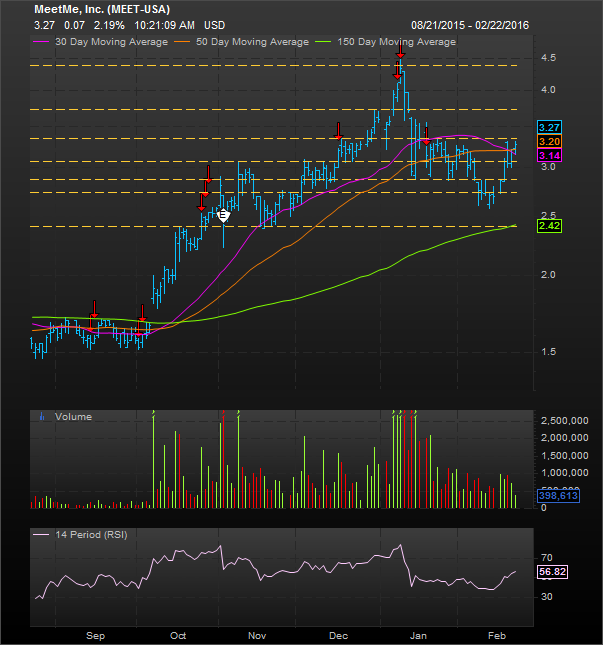
(Source: Factset)
(Source: Factset)
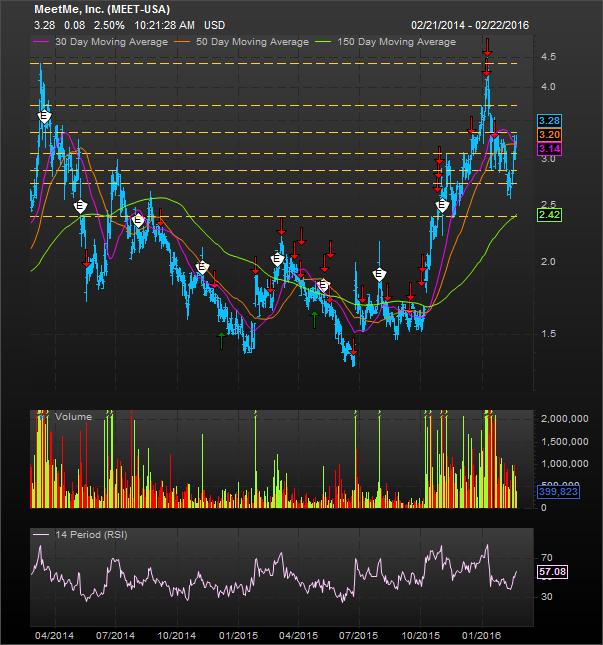
I would say that I definitely have identified a valuation discount to peers and potentially conservative analyst estimates. The technical picture looks mixed right now. The technical picture was very positive when the stock ran from a low of $3.20 on January 4, 2016 to $4.50 on January 8, 2016.
After the climax-top on 1/8/16, the chart tried to hold historically significant support at $3.07 but failed. MEET violated another important support level at $2.73, and I expected MEET to retest very strong support at $2.40. Instead, MEET found support ~$2.60. If MEET retests $2.40 or breaks through $3.34, I will change my technical assessment to positive.
Short-term investors may choose to wait until MEET retests $2.40 or breaks through $3.34 to initiate long positions. Investors with a longer investment horizon should buy MEET today because 1) the change in MEET's mobile advertising model is still not yet fully understood by the market, 2) upside is still significantly greater than downside, and 3) fundamentals will be the main driver of stock performance over multiple years.
If MEET retests $2.40 or breaks through $3.34, I will have the three traits that have marked my best investment ideas, and I will be excited to own MEET over the short, intermediate and long term.

Appendix

Internet Comps with Revenue Growth between 15% and 30%
(click to enlarge)
Internet Comps with EBITDA margins between 10% and 40%
(click to enlarge)
Social Comps
(click to enlarge)
Disclosure

The author of this posting and related persons or entities ("Author") currently holds a long position in this security which can currently be considered a long-term holding. Author may buy additional shares, or sell some or all of Author's shares, at any time. Author has no obligation to inform anyone of any changes to Author's view of MEET. Please consult your financial, legal, and/or tax advisors before making any investment decisions. While Author has tried to present facts it believes are accurate, Author makes no representation as to the accuracy or completeness of any information contained in this note. The reader agrees not to invest based on this note, and to perform his or her own due diligence and research before taking a position in MEET. READER AGREES TO HOLD HARMLESS AND HEREBY WAIVES ANY CAUSES OF ACTION AGAINST AUTHOR RELATED TO THE NOTE ABOVE. As with all investments, caveat emptor.
เขียนโดย Unknown ที่ 16:36 ไม่มีความคิดเห็น:
ส่งอีเมลข้อมูลนี้BlogThis!แชร์ไปยัง Xแชร์ไปที่ Facebookแชร์ใน Pinterest

วันพุธที่ 24 กุมภาพันธ์ พ.ศ. 2559

ปตท.เสียแชมป์กำไรสูงสุด SCBขึ้นแท่นอันดับหนึ่ง ฟันด์โฟลว์ทยอยเข้าเก็บหุ้นบิ๊กแคป

ปตท.เสียแชมป์กำไรสูงสุด SCBขึ้นแท่นอันดับหนึ่ง ฟันด์โฟลว์ทยอยเข้าเก็บหุ้นบิ๊กแคป

2016-02-25


ไทยพาณิชย์ขึ้นอันดับหนึ่งแทน PTT ครองแชมป์ทำกำไรสูงสุดประจำปี 2558 กว่า  4.7 หมื่นล้าน อันดับสองปูนใหญ่ อันดับสาม กสิกรไทย อันดับสี่ แอดวานซ์ฯ และอันดับห้า BBL ขณะที่ฟันด์โฟลว์ไหลเข้าตลาดหุ้นไทยเก็บบิ๊กแคปต่อเนื่อง 
ผู้สื่อข่าวรายงานว่า จากการรายงานผลประกอบการของบริษัทที่จดทะเบียนในตลาดหลักทรัพย์ SET และ mai โดยเฉพาะบริษัทขนาดใหญ่ประกาศผลกำไรสุทธิกันออกมาครบแล้ว พบว่า บริษัท ปตท จำกัด (มหาชน) หรือ PTT จากเดิมที่เคยมีกำไรสุทธิสูงสุดอันดับหนึ่งของตลาดฯ ในปี 2557 จำนวน 58,677 ล้านบาท แต่ปรากฏว่าในปี 2558 กำไรสุทธิได้ปรับลดลงมาเหลือเพียง 19,936 ล้านบาท ซึ่งเป็นผลมาจากราคาน้ำมันดิบในตลาดโลกปรับตัวลง ทำให้ปี 2558 ปตท.ไม่ติดอันดับบริษัททำกำไรสูงสุด 5 อันดับแรก โดยเสียแชมป์ให้กับธนาคารไทยพาณิชย์ไป
สำหรับบจ. ที่ขึ้นมามีกำไรสุทธิสูงสุด  5 อันดับแรกในปี 2558  ได้แก่  อันดับ 1 ธนาคารไทยพาณิชย์ จำกัด (มหาชน) หรือ SCB  กำไรสุทธิ 47,182 ล้านบาท แต่หากเทียบกับปี 2557 กำไรดังกล่าวปรับลดลงจากที่เคยทำได้ 53,334 ล้านบาท ทั้งนี้ในปี 2558  SCB ได้รับผลกระทบจากการตั้งสำรองพิเศษของ บมจ.สหวิริยาสตีล อินดัสตรี หรือ SSI และ SSI UK กว่า 1.1-1.2 หมื่นล้านบาทในช่วงไตรมาส 3/58
ส่วนแชมป์กำไรสูงสุด อันดับ 2 คือ บมจ.ปูนซิเมนต์ไทย หรือ SCC ที่มีกำไรสุทธิ 45,399 ล้านบาท ปรับเพิ่มขึ้นจากปี 2557 ที่มีกำไรสุทธิ 33,615 ล้านบาท
อันดับ 3 คือ ธนาคารกสิกรไทย จำกัด (มหาชน) หรือ KBANK มีกำไรสุทธิ 39,473 ล้านบาท ลดลงจากปี 2557 ที่มีกำไรสุทธิ 46,153 ล้านบาท
อันดับ 4 คือ บริษัท บริษัท แอดวานซ์ อินโฟร์ เซอร์วิส จำกัด (มหาชน) หรือ ADVANC ที่มีกำไรสุทธิ 39,152 ล้านบาท เพิ่มขึ้นจากปี 2557 ที่มีกำไรสุทธิ 36,033 ล้านบาท
และอันดับ 5 คือ ธนาคารกรุงเทพ จำกัด (มหาชน) หรือ BBL มีกำไรสุทธิ 34,180 ล้านบาท ลดลงจากปี 2557 ที่มีกำไรสุทธิ 36,332 ล้านบาท
ขณะที่วานนี้นักลงทุนต่างชาติยังคงเข้าซื้อสุทธิต่อเนื่องอีก  1,368 ล้านบาท  รวมทั้งสถาบันซื้อสุทธิ 1,072 ล้านบาท โดยนักวิเคราะห์มองว่าฟันด์โฟลว์จะไหลเข้ามาอีกประมาณ 2-3 หมื่นล้านบาท
ด้านบล.ทิสโก้ มองว่า ในเดือนมี.ค. นี้ ต่างชาติน่าจะยังเข้าซื้อในตลาดหุ้นไทยอีกประมาณ 2-3 หมื่นล้านบาท ซึ่งน่าจะเป็นปัจจัยที่ช่วยผลักดันให้ดัชนีหุ้นไทยมีโอกาสขยับขึ้นได้อีกในช่วงนี้ และในวันนี้ที่คาดว่าตลาดจะเป็นลักษณะแกว่งตัวในช่วงขาขึ้น  โดยมองแนวต้านที่ระดับ 1,345 จุด และแนวรับที่ 1,325 จุด
บล.กสิกรไทย  ยังคงมองว่า ฟันด์โฟลว์ มีโอกาสที่จะไหลเข้าตลาดหุ้นได้อีก 1.8 หมื่นล้านบาท โดยเป้าหมายหลักในการเข้าซื้อ จะยังคงเป็นบิ๊กแคปใน SET50 ซึ่งในช่วงระยะสั้นนี้จะเห็นการเปลี่ยนกลุ่มเล่นไปที่กลุ่มธนาคารมากขึ้น โดยเฉพาะธนาคารไทยพาณิชย์ หรือ SCB, ธนาคารกรุงไทย หรือ KTB, ธนาคารกรุงเทพ หรือ BBL  และบมจ.ทิสโก้ไฟแนนเชียลกรุ๊ป หรือ TISCO
สำนักวิจัย บริษัทหลักทรัพย์ ทิสโก้ แนะนำกลุ่มแบงก์ Outperform จากการประเมินมูลค่าและสินเชื่อเริ่มคงตัว ดาวน์ไซด์จำกัดจากสินเชื่อที่ฟื้นตัวและราคาที่น่าสนใจ งบดุลในเดือนม.ค. ออกมาตามที่คาด โดยสินเชื่อเริ่มโตขึ้น YoY ด้วยดาวน์ไซด์ที่จำกัดจากการประเมินมูลค่า, กระแสเงินทุนไหลเข้าและการชะลอการขึ้นดอกเบี้ยของ เฟดส่งผลดีต่อกลุ่มธนาคาร
ด้านนายมนตรี ศรไพศาล ประธานเจ้าหน้าที่บริหาร บริษัทหลักทรัพย์ เมย์แบงค์ กิมเอ็ง (ประเทศไทย) จำกัด มหาชน หรือ MBKET คาดว่าดัชนีฯ สิ้นปีจะอยู่ที่ 1,600-1,650 จุด โดยประเมินมูลค่าการซื้อขายเฉลี่ยต่อวันปีนี้เพิ่มขึ้นไม่น้อยกว่า 10% จากปีก่อนที่ 4.4 หมื่นล้านบาท ปัจจัยบวกจะมาจากโครงการลงทุนของภาครัฐที่จะช่วยกระตุ้นความเชื่อมั่น 

เขียนโดย Unknown ที่ 13:51 ไม่มีความคิดเห็น:
ส่งอีเมลข้อมูลนี้BlogThis!แชร์ไปยัง Xแชร์ไปที่ Facebookแชร์ใน Pinterest
ป้ายกำกับ: ADVANC, bbl, fund flow, kbank, PTT, scb

Why You Should Own Alibaba

Why You Should Own Alibaba

What makes Alibaba stand out as a profitability trailblazer in an industry plagued by non-existent profit margins?
What are the three elements of their business that Amazon would do well to learn from?
Find out what Alibaba's future holds as the market promises double-digit growth for several years to come.
Jack Ma, Founder of Alibaba
Alibaba (NYSE:BABA), in many ways, looks to be a mirror image of Amazon (NASDAQ:AMZN). At the very least, they seem to be inspired in the past by the company that took the retail market online.
Alibaba's cloud computing service is another example: The company did exactly what Amazon did - turn a cost center into a profit-making business. In Amazon's case, that business now rivals its core retail business in terms of profitability.
Now, however, things seem to have turned around. Amazon's Dragon Boat idea of connecting sellers in one continent to buyers in another seems to be inspired by none other than Alibaba.
Moreover, since Alibaba started putting together the pieces for cross-border trade, Amazon can only stand by and watch as the Chinese profitability machine enters Amazon's own domain of international sales.
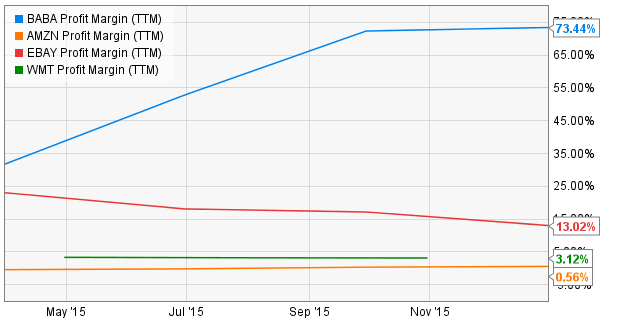
But those seem to be the only parallels one can draw between the two companies. Alibaba's profitability alone sets it apart from any other major e-commerce or retail company in the world.
How Profitable is Alibaba?
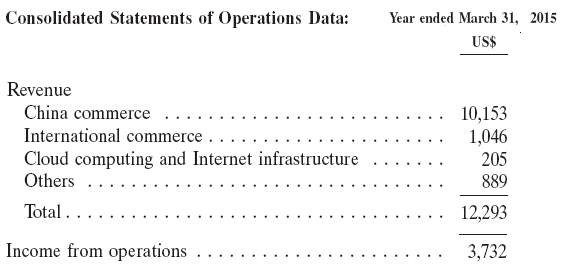
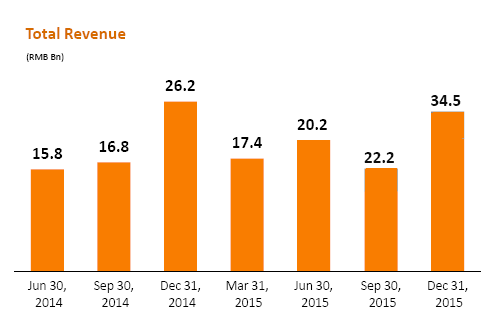
In 2015, Alibaba earned $12.3 billion in sales with net profits touching $3.7 billion; that's almost one billion more in profits than Amazon, which did nearly nine times Alibaba's sales. But one year of data does not a trend make. Let's take a closer look at Alibaba's operational efficiency and profitability to see if they're really sustainable into the future.
Just a quick look at their profit margin numbers in the last few quarters makes you question if it's an anomaly. How can a company that earns most of its revenue (83%+) from China alone be more profitable than retail stalwarts such as Amazon, Wal-Mart (NYSE:WMT) and eBay (NASDAQ:EBAY) that have global footprints?
The answer to that is multifaceted.
Why Is Alibaba So Profitable?
The Business Model Advantage
First of all, Alibaba is a marketplace, earning fees for connecting buyers to sellers online. It does not buy products from manufacturers and then try and sell them to customers. That one difference in their business model puts them in a category that's different from Amazon and Wal-Mart, but not eBay. Because Alibaba is primarily a commissions-based business, they're able to shed much of the overhead burden that retailers and e-tailers are encumbered with.
Think of it in terms of a real estate agent versus a real estate seller. The former connects the right buyer to seller, processes the necessary paperwork, closes the deal and pockets the commission. That's Alibaba and eBay.
On the other hand, Wal-Mart is similar to a real estate investor who buys homes, finds buyers and does all the work so the buyer only has to sign on the dotted line and write the check.
Amazon does the same, but they want to have it all: They want to buy and sell their goods, and be a broker to several third party sellers at the same time.
In terms of business models, all three work... and very well, too. Amazon's $107 billion and Wal-Mart's $480+ billion in sales are testament to that. However, that's not where their profitability comes from. What they keep in the end is a much smaller percentage than what Alibaba or even eBay keep, as you saw in the operating profit comparative graph above.
The Hands-off Logistics Advantage
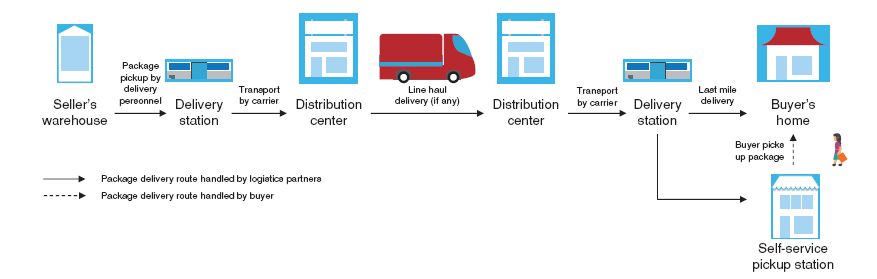
The second key to profitability is the way Alibaba handles its logistics and last-mile delivery. Contrary to what most e-tailers do, the company has a hands-off approach to its logistics. That might seem counter-intuitive when you consider that the typical e-tailer is paranoid about having control over their delivery capabilities. Make no mistake - Alibaba is as meticulous about error-free delivery as any company, but they do it with a twist.
Source: BABA 2014 Annual Report
For the most part, they allow the seller to choose a delivery company that will fulfill the order. The selected logistics company is then tasked with the pickup of the product, warehousing, line-haul and last mile delivery. Alibaba's Cainiao Logistics takes on the job of selecting vendors for delivery, sharing data and overall management of the process - and that gives them the level of control they need, as well as the data to drive their business to higher levels of efficiency.
Leveraging its technology expertise, Alibaba then facilitates visibility for both buyer and seller to keep track of the product's delivery life cycle.
The process of only doing the supervisor's job with respect to delivery is what I believe to be one of the key aspects of Alibaba's profitability - one that puts them far ahead of even companies like eBay with a similar sales model.
The establishment of a separate logistics division is a big move, so their current model is geared to collecting all the data they need to optimize delivery routes and create a profitable division if they choose to start their own delivery system.
The Relationship Edge
The third advantage Alibaba has over other e-tailers is the solid working relationships they've built with all their partners and vendors. For example, when Alibaba created Cainiao Logistics in 2013, it was a wholly-owned subsidiary of a joint venture between five express delivery companies in China. Talk about convincing enemies to be friends and work together so everyone benefits in the end! I'd almost say it was the Tao of business building!
At the other end of the spectrum is the typical e-tail model, which pits vendors against each other for the cheapest price and ends up hurting the relationship in the process. Most e-commerce companies have a love-hate relationship with their vendors and partners; case in point is Amazon's pseudo-symbiotic relationship with UPS (NYSE:UPS) - despite being their biggest customer, Amazon does not have the relationship with UPS that Alibaba enjoys with its logistics partners.
This positioning of Alibaba as a great friend of all businesses has been helping the company to no end. I only wish Amazon and just about every other retailer - online or offline - could take a leaf out of their book and let go of their obsession about controlling everything they touch.
Investor-Speak: The BABA Opportunity
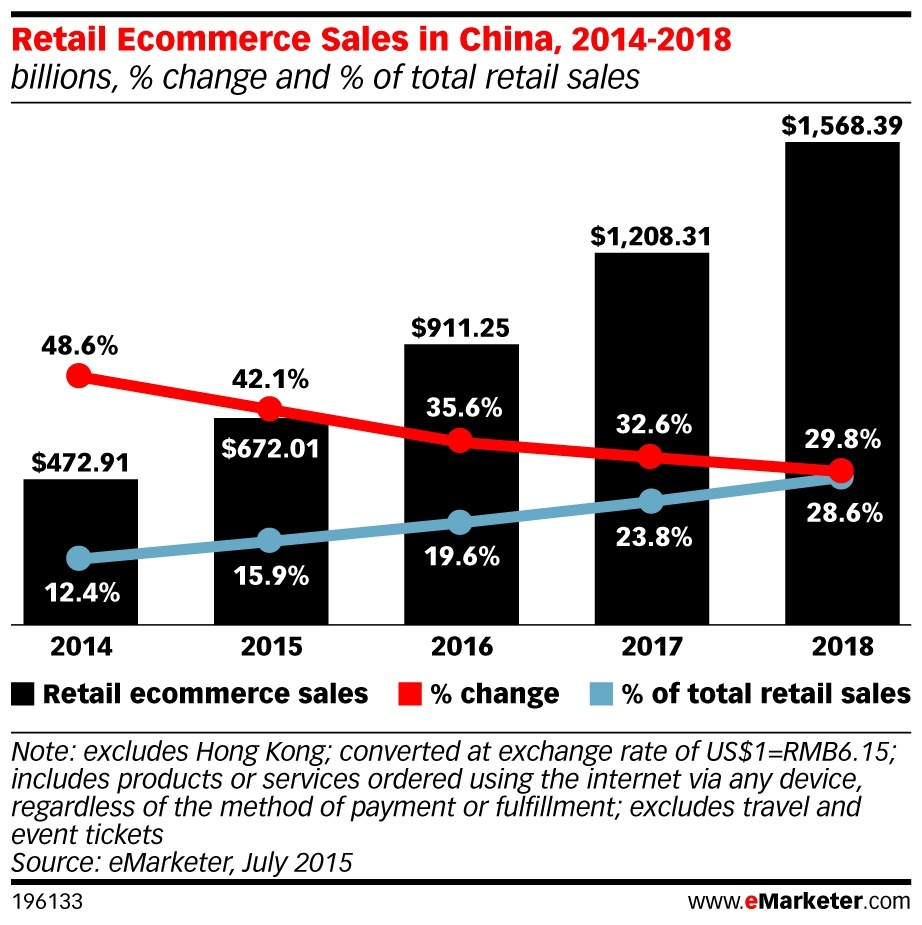
There is a huge amount of variance in market size growth estimates for the Chinese retail e-commerce segment. Techcrunch says it's growing at 19.9% per annum and will hit $1 trillion by 2019; AT Kearney puts that at $1.5 trillion after crossing $718 billion in 2017; emarketer says it will hit $1.5 billion a year earlier, in 2018.
All the estimates, however, agree that there will be double-digit growth over the next four to five years. As the Alpha e-tailer in China, Alibaba's revenues will grow in proportion to that figure. We've already seen them growing their top line by double-digit percentages quarter over quarter over the past couple of years.
The company is still in growth phase and will be for several years to come. With their careful foray across the border, they're not going to be making the mistakes eBay or even Amazon did, for that matter. Their profit margins give them the leverage they need to experiment outside the country, but I believe they'll follow the same course of action they did when expanding their China business. That is, evaluate possible synergies, keep risks low and build a backbone on which to overlay their business model.
Even at this seemingly high price point, there's still a safety net if you're keen on adding BABA to your portfolio.
If you enjoyed reading this article, I invite you to follow me and comment on my other workon retail, e-commerce, sportswear, automobile, technology and other consumer industries.
Disclosure: I/we have no positions in any stocks mentioned, and no plans to initiate any positions within the next 72 hours.
I wrote this article myself, and it expresses my own opinions. I am not receiving compensation for it (other than from Seeking Alpha). I have no business relationship with any company whose stock is mentioned in this article.
เขียนโดย Unknown ที่ 03:25 ไม่มีความคิดเห็น:
ส่งอีเมลข้อมูลนี้BlogThis!แชร์ไปยัง Xแชร์ไปที่ Facebookแชร์ใน Pinterest
ป้ายกำกับ: ALIBABA, BABA

วันเสาร์ที่ 20 กุมภาพันธ์ พ.ศ. 2559

Stock Yields Over 15%, Reported Record Earnings, Selling Way Below Book Value

High-Dividend Stock Yields Over 15%, Reported Record Earnings, Selling Way Below Book Value

Looking for high dividend stocks with well-covered payouts? In this new era of dividend slashing, it's refreshing to find a stock that is maintaining its payouts. You would think that such a solid citizen would've been amply rewarded by the market, but it hasn't...until the past month.
We've written about some other shipping stocks in recent articles, many of which have begun to get some respect from bargain hunters.
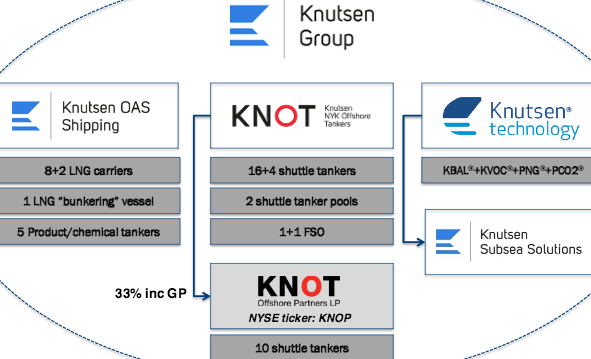
Profile: KNOT Offshore Partners LP (NYSE:KNOP) is a limited partnership formed in February 2013 to operate and acquire shuttle tankers under long-term charters. KNOP owns and operates 10 shuttle tankers under long-term charters in the North Sea and Brazil.
KNOP's sponsor, Knutsen NYK Offshore Tankers AS (Knutsen NYK), is a market leading independent owner and operator of shuttle tankers, which is jointly owned by TS Shipping Invest AS - TSSI, and Nippon Yusen Kaisha - NYK. TSSI is a private Norwegian company with ownership interests in shuttle tankers, liquefied natural gas tankers and product/chemical tankers. NYK is a Japanese public company with a fleet of approximately 800 vessels, including bulk carriers, containerships, tankers and specialized vessels. As of September 30, 2015, Knutsen Group owned a 30.7% limited partner interest in KNOP and a 2% general partner interest in KNOP, as well as the incentive distribution rights.
The company provides crude oil loading, transportation and storage services under time charters and bareboat charters. The company is headquartered in Aberdeen, the United Kingdom.
(Source: KNOP website)
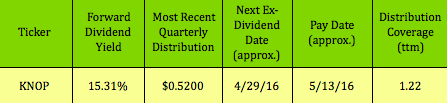
Distributions: KNOP has a very attractive yield of 15.31%, with strong trailing 12-month distributable cash flow coverage of 1.22x.
Our High Dividend Stocks By Sector Tables track KNOP's price and current dividend yield (in the Energy section):
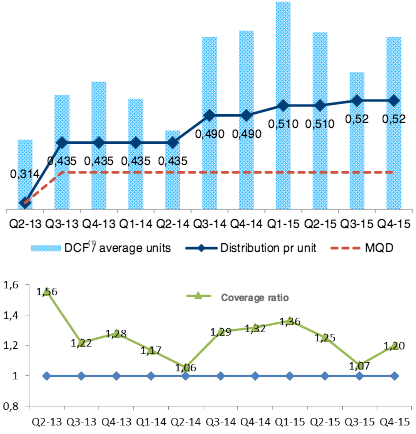
KNOP's distributions have increased by 39% over the minimum quarterly distribution in the 10 distributions since the 2013 IPO:
Taxes: Here's another attraction - KNOP's distributions are reported to unitholders on a 1099, and qualify for the qualified dividend tax treatment in the US.
(Source: KNOP website)
Options: KNOP currently has an attractive July 2016 put option available. The $12.50 put strike sells for a bid of $1.20, a 9.6% yield over around five months, or 23.68% annualized.
You can see more details for this and over 30 other put-selling trades in our Cash Secured Puts Table:
KNOP's call options aren't currently that attractive, but you can find many other trades in our Covered Calls Table, which tracks over 30 income-producing trades.
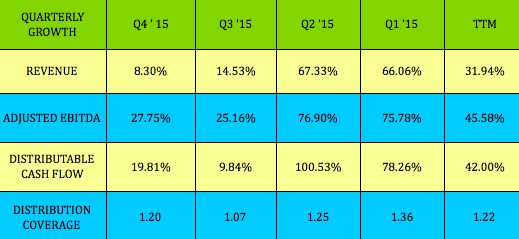
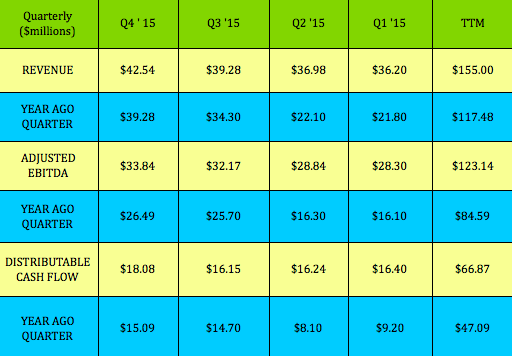
Earnings: Although its Q1 and Q2 2015 growth percentages were the most robust, KNOP has had steady quarterly growth over the past four quarters and just reported an outstanding Q4 2015.
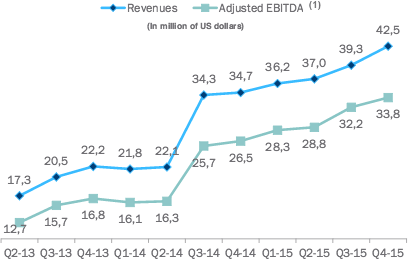
KNOP reported record revenue, EBITDA and DCF in Q4 2015:
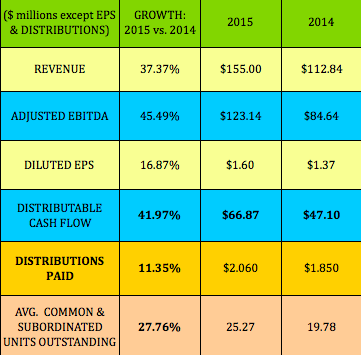
2015 vs. 2014: These are heady growth numbers for a non-tech stock, eh? Even with the unit count rising over 27%, EPS still rose nearly 17%, revenue grew 37%, EBTDA rose 45%, and DCF was up nearly 42%.
KNOP's numbers really ramped up in late 2014 and in 2015 as it added vessels. It has grown its fleet by 150% since its 2013 IPO:
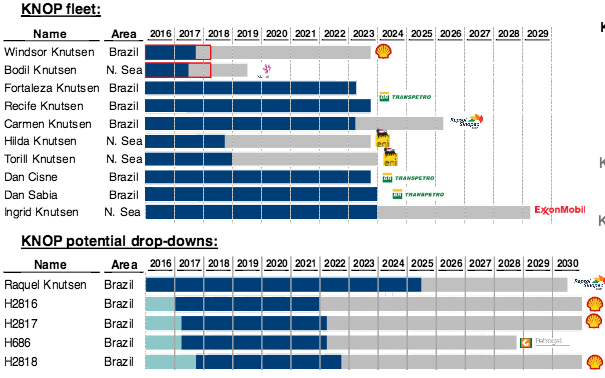
KNOP's fleet has an average remaining contract length of 5.6 years, with 2.5 years average extension. It also has the option to acquire five more dropdown vessels from its sponsor, all of which have long-term contracts, with extension options, with strong counterparties, such as Royal Dutch Shell (NYSE:RDS.A) (NYSE:RDS.B), Exxon Mobil (NYSE:XOM), Statoil (NYSE:STO) and ENI, among others:
Shuttle tankers occupy a small, vital niche market - shippers/producers can't monetize their oil or LNG unless they get it from the transport ship to the mainland, and it's way more expensive to build a pipeline to do this, than to contract with a shuttle company like KNOP.
(Source: KNOP website)
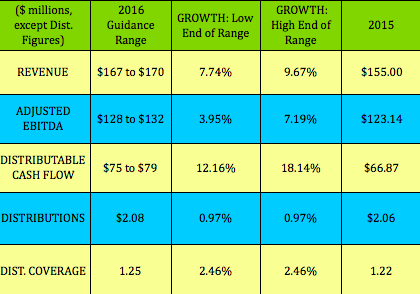
2016 Guidance: On the 2/17/16 Q4 and full-year 2015 earnings release, KNOP's management issued guidance ranges for 2016, projecting good growth for revenue, EBITDA and DCF.
Although DCF should grow by 12% to 18%, they're currently being conservative, and forecasting a steady distribution of $.52/quarter, which would be 2.46% above the 2015 distribution.
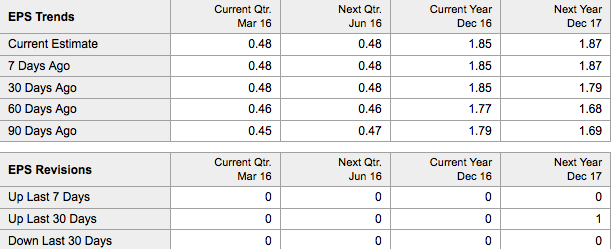
Analysts Estimates and Price Targets: Analysts raised their consensus earnings estimate from $1.77 to $1.85, which would represent 15.6% growth in EPS vs. $1.60 in 2015.
(Source: Yahoo Finance)
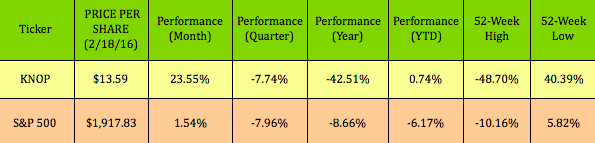
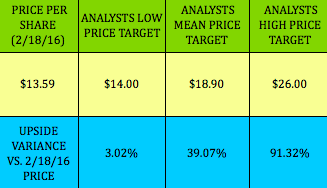
Even though KNOP is up over 23% in the past month, it's still 39% below analysts' mean price target of $18.90:
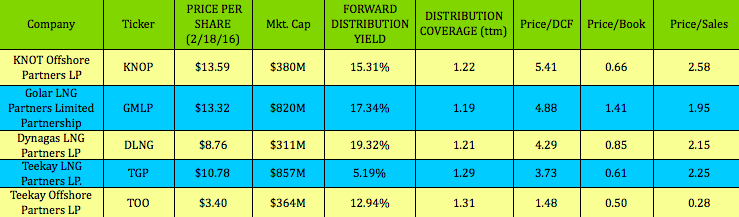
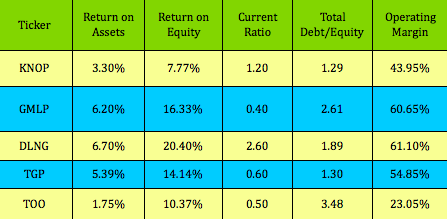
Valuations: We put together a comparison valuation chart which also includes some other stocks we've covered recently, including Golar LNG Partners, (NASDAQ:GMLP) and Dynagas LNG Partners, (NYSE:DLNG), in addition to Teekay LNG Partners, (NYSE:TGP) and Teekay Offshore Partners, (NYSE:TOO).
These stocks all have very low price/DCF/unit valuations, and KNOP and DLNG have the additional attraction of selling below their book values. KNOP is selling at just 66% of its book value.
TGP and TOO may have the highest distribution coverage, but they also slashed their distributions in Q4 2015, TGP went from $.56 to $.11, and TOO dropped from $.70 to $.14, respectively.
Financials: Although its ROE is the lowest, and its ROA is lower than most of the group, KNOP has the lowest debt/equity ratio of this group.
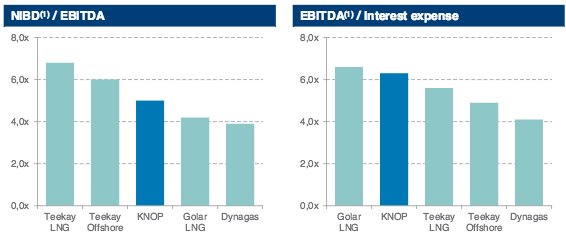
Debt: KNOP's current EBITDA/interest expense ratio is a strong 7.2x, much higher than its bank's required 2.5x ratio. Even adding in depreciation, its EBIT/interest expense ratio is still 4.7x.
(Source: KNOP website)
All tables furnished by DoubleDividendStocks.com, unless otherwise noted.
Disclaimer: This article was written for informational purposes only. Please practice due diligence before investing in any investment vehicle mentioned in this article.
I wrote this article myself, and it expresses my own opinions. I am not receiving compensation for it (other than from Seeking Alpha). I have no business relationship with any company whose stock is mentioned in this article.
เขียนโดย Unknown ที่ 17:04 ไม่มีความคิดเห็น:
ส่งอีเมลข้อมูลนี้BlogThis!แชร์ไปยัง Xแชร์ไปที่ Facebookแชร์ใน Pinterest
ป้ายกำกับ: dividend yield

วันศุกร์ที่ 19 กุมภาพันธ์ พ.ศ. 2559

Twitter's Fault Highlights Facebook, Inc.'s Strength

Twitter's Fault Highlights Facebook, Inc.'s Strength
Twitter's (NYSE:TWTR) biggest problem -- stagnating user growth -- could highlight the best reason for Facebook (NASDAQ:FB) shareholders to continue holding shares. As the smaller social network struggles to grow its user base, just as Facebook's user growth continues as strongly as ever, the social network's mass-market appeal and its continual ability to grow users can be better appreciated.Twitter User Growth QTWITTER USER GROWTH. IMAGE SOURCE: TWITTER.
Twitter's problemWhen news of the simultaneous departure of a handful of Twitter executives in late January surfaced, speculation mounted that the social network's decelerating user growth, which had been worrying investors, might have failed to improve during the company's fourth quarter. And this speculation was correct: Twitter's core users actually declined slightly between Q3 and Q4.
The company reported 320 million total monthly active users in Q4, the same as it reported in Q3. But when excluding the company's SMS Fast Followers -- lower-value users who primarily access the service from SMS on feature phones -- Twitter's core user base actually declined from 307 million to 305 million during this same period.
To comfort investors, management did note in Twitter's fourth-quarter shareholder letter that monthly active users in the month following the close of the fourth quarter have returned to Q3 levels. Further, management said the company is confident this growth trend will "continue over time."
Facebook's strengthMeanwhile, the narrative at Facebook on user growth is quite different. With user growth remaining strong both on a year-over-year and sequential basis, there's no talk of stagnation when the larger social network provides quarterly updates.
Facebook's fourth-quarter monthly active users hit 1.59 billion during Q4, up 14% year over year and 3% sequentially -- well beyond Twitter's 9% year-over-year and 0% sequential growth during these same periods, respectively. Further, Facebook's sequential growth in monthly active users isn't showing any signs of deceleration, like Twitter's is.Facebook Mau GrowthDATA FOR CHART RETRIEVED FROM COMPANY SEC FILINGS FOR QUARTERS SHOWN. CHART SOURCE: AUTHOR.


Facebook's strong user growth compared to Twitter's decelerating growth highlights Facebook's mass-market appeal versus Twitter's seemingly limited appeal.
Facebook stands out from Twitter as the service capable of sustaining growth over the long haul. Growing meaningfully on a much larger user base than Twitter, Facebook has proven to investors that its service appeals to the masses. Even Facebook's CEO Mark Zuckerberg's aspirations to eventually reach five billion monthly active users on the social network doesn't seem far fetched. Further, the company's ability to replicate mass-market appeal with its other social platforms further demonstrates the company's ability to build massive social networks.
Twitter investors, on the other hand, can't rely on the same quantifiable evidence Facebook investors get when it comes to expectations for attracting a larger user base. Instead, investors have to simply trust that management can solve its user growth problem and potentially transform the product into one that appeals to a larger audience.
Going forward, investors may be more diligent when attempting to analyze the addressable markets for social networks when considering them as potential investments.
Get in on this stock before the more big investors doStocks can really take off when big-time investors buy in... so you want to be in before that happens. And now a man some call the world's No. 1 growth investor is recommending a small company whose technology is inside every single iPhone sold. As well as phones from almost all other major manufacturers! This market is enormous. Find out more about this small company with BIG potential right here.

เขียนโดย Unknown ที่ 09:43 ไม่มีความคิดเห็น:
ส่งอีเมลข้อมูลนี้BlogThis!แชร์ไปยัง Xแชร์ไปที่ Facebookแชร์ใน Pinterest
ป้ายกำกับ: FB, TWITTER, TWTR

วันพุธที่ 17 กุมภาพันธ์ พ.ศ. 2559

Are Dividends Doomed?

Are Dividends Doomed?

Due to its over-reliance on dividends, which might stop growing or even disappear completely, Dividend Growth Investing is a fatally flawed strategy. In an article published over the weekend, the New York Times suggests as much (without ever specifically mentioning DGI).
The article, headlined Dividends, Wall Street's Battered Status Symbol, starts by saying Coca-Cola (NYSE:KO) has increased dividends for 50 years and has paid income to shareholders since 1920. Therefore, Times journalist Jeff Sommer says, it's "unthinkable" for Coke to cut divvies. He goes on to write:
Many other companies would love to say the same, but they can't. Companies hate to cut dividends because they know that such an announcement would hurt their reputation with investors. Yet in a difficult financial environment, startlingly large numbers of corporations are slashing dividends anyway. That trend is disturbing.
The article then mentions grim numbers compiled by Howard Silverblatt, senior index analyst at S&P Dow Jones Indices: In 2015, 394 companies cut dividends, a 38% increase over 2014 and even 23% more than in 2008, in the midst of the Great Recession.
The only year in recent history with more dividend cuts was in 2009, when the world was staggering through a great financial crisis. A total of 527 companies trimmed dividends that year, Mr. Silverblatt's data shows. Coca-Cola and other dividend-paying blue chips like IBM and McDonald's were under severe stress in those days, too, but their financial resources were deep enough to allow them to keep the dividend stream fully flowing.
They were happy exceptions. A host of other major companies - like Alcoa, General Electric, Dow Chemical, Macy's, Sotheby's, JPMorgan Chase and Bank of America - decided, under considerable pressure, that it was time to capitulate. They all cut their dividends.
Exceptions? Really?
The article's wording makes it seem Coca-Cola, IBM (NYSE:IBM) and McDonald's (NYSE:MCD) were among a very small group of "happy exceptions" to the dividend-cutting wave of 2009, while General Electric (NYSE:GE), Bank of America (NYSE:BAC) and other income-slashers represented the norm.
In reality, KO, IBM and MCD were part of the majority. Such blue-chip, income-growing companies indeed did have - using the author's own words - "financial resources deep enough to allow them to keep the dividend stream fully flowing" through the worst financial crisis since the Great Depression. Which is why DGI practitioners tend to invest in such companies.
Seeking Alpha contributor David Fish has created and maintained the official list of Dividend Champions, Contenders and Challengers - companies that have raised dividends for at least 25, 10 and 5 years, respectively. According to David, more than 70% of the companies that qualified as Champions going into the recession kept raising dividends. Another 9% froze divvies but did not cut them.
Furthermore, at the end of last month, there were 106 Champions and 251 Contenders. Those 357 companies have been growing dividends for at least 10 years, meaning they obviously weren't cutting them from 2007-2009.
That seems to be more than a handful of "happy exceptions," no? And I think it's safe to say those 357 include the most popular companies owned by DGI proponents.
We're Doomed! Doomed, I Say!
Following is a fairly important passage tucked into the ninth paragraph of the Times article. (I have bolded what I considered most relevant.)
The situation today isn't nearly as dire for most companies as it was in 2009, and the stock market and the economy generally appear to be much stronger. Nor are all companies cutting dividends. In fact, overall, corporate dividends rose last year and, barring a severe economic shock, they are likely to do so in 2016. So are stock buybacks, the other widely used method of returning cash to investors.
In other words, just a few paragraphs after the author's ominous warning of an impending Dividend Doomsday - Cuts! Eliminations! Run for the hills! - he acknowledges that dividends actually have been rising and almost certainly will continue growing.
Having dealt a blow to his own thesis, Sommer steers the conversation to "pockets of pain... especially in the energy and commodities sectors." He names troubled oil companies ConocoPhillips (NYSE:COP) and Anadarko Petroleum (NYSE:APC) and mining giant Rio Tinto (NYSE:RIO).
Well yes, everybody knows that those sectors are under severe pressure - and that far more than dividends have been lost. Investors who use strategies other than DGI have been crushed by declining share prices, too. (And do I even need to mention that neither APC nor RIO are exactly classic DGI portfolio holdings?)
The article also talks about buybacks being reduced, and uses Exxon Mobil (NYSE:XOM) as a prime example.
Consider Exxon Mobil's moves early this month. They were drawn from the classic corporate finance playbook. It said that dividends were a "priority," and unlike Conoco, it said that it would maintain them and preserve its ability to make important capital investments during the oil price downturn.
Once the biggest practitioner of buybacks in the stock market, Exxon has been paring them for the last two years, and announced that it would reduce them more radically to conserve cash. Exxon's shares have actually risen slightly this month while Conoco's have fallen sharply.
Most Dividend Growth investors I know prefer income to buybacks. Most also considered XOM a higher-quality company than COP even before the latter slashed its dividend 66%. (Disclosure: I dumped COP from my personal portfolio at $47.59/share on Jan. 4, before its divvy cut and accompanying price freefall. Both COP and XOM do remain part of the Dividend Growth 50 portfolio I oversee.)
What About Indexing?
Sommer extols the wonders of indexing, so that "even if dividend cuts portend market declines, you can prosper if you can endure some pain." He cites the S&P 500 Index's (NYSEARCA:SPY) 200% return since March 2009 without mentioning the 57% drawdown of the preceding couple of years.
The Times writer adds this interesting tidbit:
Indexes of stocks with high and stable dividends did even better. That may be because steady dividend payers are more solid. It may simply be that investors prefer dividends. We don't really know.
Let that one roll around in your brain for a few moments. Even as he gushes about SPY, the author must admit the advantages of owning the very companies that populate DGI portfolios.
Sommer concludes:
But people who have truly relied on dividends for income may have to face a sad truth. Dividends aren't bonds, and they may be cut at a company's discretion. So love dividends if you must. Just don't count on them.
It's absolutely true that DGI does not offer a money-back guarantee. Of course, the wording of that paragraph could have been altered slightly to discuss the perils and pitfalls of any investing strategy:
But people who have truly relied on share-price appreciation to fund their lifestyles may have to face a sad truth. Stocks - and even stock index funds - aren't bonds, and they may sustain severe, prolonged share-price reductions. So love Modern Portfolio Theory (or total return or growth or momentum or contrarian or technical analysis or day trading or Strategy X) if you must. Just don't count on it.
Emphasizing The Probable
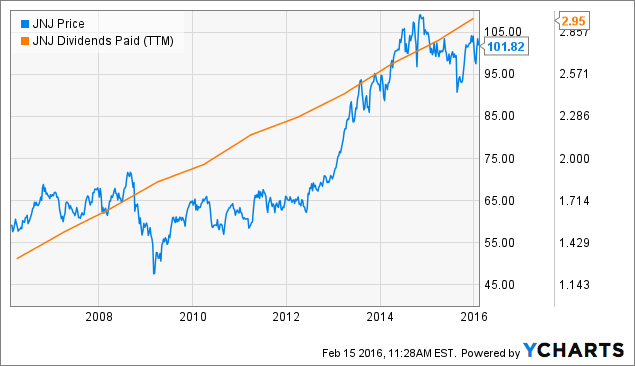
Most DGI practitioners are realists. We know earnings must increase over time if dividends also are to grow. Some of us have learned hard lessons taught by GE (NYSE:GE) and Alcoa (NYSE:AA)... but we also have benefited over time from Altria (NYSE:MO) and Johnson & Johnson (NYSE:JNJ). We realize the importance of diversification, of quality and of valuation.
JNJ Chart
We acknowledge that JNJ could suffer through such horrible times that it would end its decades-long string of dividend growth, but we strongly believe the probabilities are on our side. That's why the core of my portfolio includes the likes of Johnson & Johnson, McDonald's, Coca-Cola, Altria, 3M (NYSE:MMM), AT&T (NYSE:T), Procter & Gamble (NYSE:PG) and General Mills (NYSE:GIS). The notion of them slashing their dividends is, as New York Times writer Jeff Sommer might say, "unthinkable."
I wrote this article myself, and it expresses my own opinions. I am not receiving compensation for it (other than from Seeking Alpha). I have no business relationship with any company whose stock is mentioned in this article.
เขียนโดย Unknown ที่ 17:38 1 ความคิดเห็น:
ส่งอีเมลข้อมูลนี้BlogThis!แชร์ไปยัง Xแชร์ไปที่ Facebookแชร์ใน Pinterest
ป้ายกำกับ: dividend yield, IBM, KO, MCD
บทความที่ใหม่กว่า บทความที่เก่ากว่า หน้าแรก
สมัครสมาชิก: ความคิดเห็น (Atom)

คลังบทความของบล็อก

  • ▼  2016 (91)
    • ►  เมษายน (7)
    • ►  มีนาคม (14)
    • ▼  กุมภาพันธ์ (32)
      • Meetme
      • ปตท.เสียแชมป์กำไรสูงสุด SCBขึ้นแท่นอันดับหนึ่ง ฟัน...
      • Why You Should Own Alibaba
      • Stock Yields Over 15%, Reported Record Earnings, S...
      • Twitter's Fault Highlights Facebook, Inc.'s Strength
      • Are Dividends Doomed?
      • Nikkei เด้ง7.16%
      • THAIกำไรไตรมาสสุดท้าย4พันล้าน แต่ทั้งปีขาดทุน1.4หม...
      • Beauty เนื้อหอมกองทุนต่างชาติแห่ลงทุน
      • EPGกำไรไตรมาสสามปี2559โตแกร่ง
      • Risk of weaker yuan on Thai baht
      • Warren Buffet and subprime crisis
      • GPSC โชว์กำไรปี 58 โตกว่า 20% ปันผล 0.95 บ./หุ้น X...
      • Jasจะทำอย่างไร
      • ยังคงมีแรงเทขายรุนแรงในตลาดเอเชีย
      • “INTUCH” ลุ้นกำไรปี 58 พุ่ง 15,800 ล้านบาท รับผลบว...
      • หวั่นหยวนอ่อนค่า ความเสี่ยงที่ต้องจับตามอง / Flash...
      • ตลาดการเงินโลกมีความเสี่ยงเพิ่มสูงขึ้น
      • jas
      • New Economy สำหรับ Emerging Market กวี ชูกิจเกษม
      • Jas อาจต้องคืนคลื่น900
      • สถาบันฯ เปิดโผหุ้นกลุ่มปันผล ดันผลงานปี 58 โดดเด่น...
      • ฟันด์โฟลว์ไหลเข้าเก็งกำไรหุ้นปันผลดี หลังธนาคารกลา...
      • “วรภัค” เผยยังไม่มีแนวคิดที่จะเข้าเทกโอเวอร์กิจการ...
      • นักลงทุนสถาบันเปิดโผ 10 หุ้นเด่นทำกำไรงาม นำทีมโดย...
      • “EPG” ลุ้นกำไร 9 เดือนแรกพุ่งทะลุ 1,000 ล้านบาท โต...
      • ซาอุดีอาระเบียได้หาทางซื้อเวลาให้ตัวเองนานสองเดือน...
      • “เอชเอสบีซี”งดรับพนักงาน โตโยต้าระงับการผลิตในญี่ป...
      • “ทรู” เพิ่มทุนฟ้าแลบ! วงการคาดเคาะราคาขาย 4-6 บาทต...
      • “บางจาก” ทุ่มงบ 2,915 ล้านบาท ส่ง “บีซีพีจี” ซื้อก...
      • “WICE” ปักธงปี 59 ปั๊มรายได้ 900 ล้านบาท โต 30% เน...
      • “ซีพีเอฟ” ลุ้น Q4/58 มีกำไรสุทธิ 1,665 ล้านบาท โต ...
    • ►  มกราคม (38)
  • ►  2015 (210)
    • ►  ธันวาคม (23)
    • ►  พฤศจิกายน (1)
    • ►  ตุลาคม (6)
    • ►  กันยายน (28)
    • ►  มิถุนายน (3)
    • ►  พฤษภาคม (30)
    • ►  เมษายน (40)
    • ►  มีนาคม (33)
    • ►  กุมภาพันธ์ (19)
    • ►  มกราคม (27)
  • ►  2014 (412)
    • ►  ธันวาคม (44)
    • ►  พฤศจิกายน (66)
    • ►  ตุลาคม (60)
    • ►  กันยายน (12)
    • ►  สิงหาคม (32)
    • ►  กรกฎาคม (43)
    • ►  มิถุนายน (4)
    • ►  พฤษภาคม (6)
    • ►  เมษายน (32)
    • ►  มีนาคม (37)
    • ►  กุมภาพันธ์ (34)
    • ►  มกราคม (42)
  • ►  2013 (1286)
    • ►  ธันวาคม (59)
    • ►  พฤศจิกายน (132)
    • ►  ตุลาคม (248)
    • ►  กันยายน (110)
    • ►  สิงหาคม (93)
    • ►  กรกฎาคม (107)
    • ►  มิถุนายน (176)
    • ►  พฤษภาคม (235)
    • ►  เมษายน (126)

เกี่ยวกับฉัน

Unknown
ดูโปรไฟล์ทั้งหมดของฉัน
การเดินทาง ธีม. ขับเคลื่อนโดย Blogger.